Showing posts with label Thriller. Show all posts

Thursday, September 14, 2017

Volume 11 - Rope and the Privilege of Murder

When you're having an Alfred Hitchcock Month!, as we currently are, there are certain topics you have to bring up. Women, suspense, mystery, and humor are certainly among them. But, in most situations, you can't talk about Hitchcock without talking about murder. I haven't done the math on this topic, but I think it's entirely possible that all of Alfred Hitchcock's films have some kind of murder going on, even if sometimes it's a murder of crows. (We'll get to that one of these weeks, I promise.)

While more than a handful of Hitchcock's films are built around a murder, there's one particular Hitchcock film that stands out because the entire film is devoted to a bunch of people, in one room, where a murder has just happened. It's not a mystery who did the killing, and why the murder happened is spelled out pretty neatly for us early on. If you're thinking that this doesn't seem like the formula for a Hitchcock thriller, you're right. And that's one reason why the film we're about to talk about stands out as one of the director's most interesting projects.

HOW THIS WORKS
Step 1) I pick a movie.
Step 2) I tell you about the movie.
Step 3) I tell you what we're looking for in a double feature movie.
Step 4) Another movie!
Step 5) Victory!

Rope
1948, Directed by Alfred Hitchcock

If Hitchcock's films were a line of toys, Rope is one of the ones that would have been sent to the island of misfit toys. It has a lot of the things we often expect from his films - murder, intrigue, a marvelous James Stewart performance - but it's certainly his most contained film. I don't mean that in regard to its themes, I mean that the action is literally contained in one room. Even Rear Window spends more time outside than this one does, and that's the movie where Mr. Stewart is confined to a wheelchair.

Rope opens in a dark New York City apartment with the murder of David Kentley, strangled to death with a length of rope by two of his college classmates, Brandon and Phillip. The two killers aren't the type of characters you'd expect to find as the killers in an Alfred Hitchcock film, they're simply two Harvard educated guys who thought murder could be an art. They're also obviously gay lovers, though the film never mentions this, which is one more reason Rope felt like such an outlier when it was released in 1948. Several theaters banned the film, not because of the murder, but because of the implied homosexuality.

Brandon and Phillip become the focal point of the film from the first frame, and they're two of Hitchcock's most vibrant characters, but for very different reasons. Brandon, played by John Dall, is smug and confident, laughing off the murder because it was so perfect.
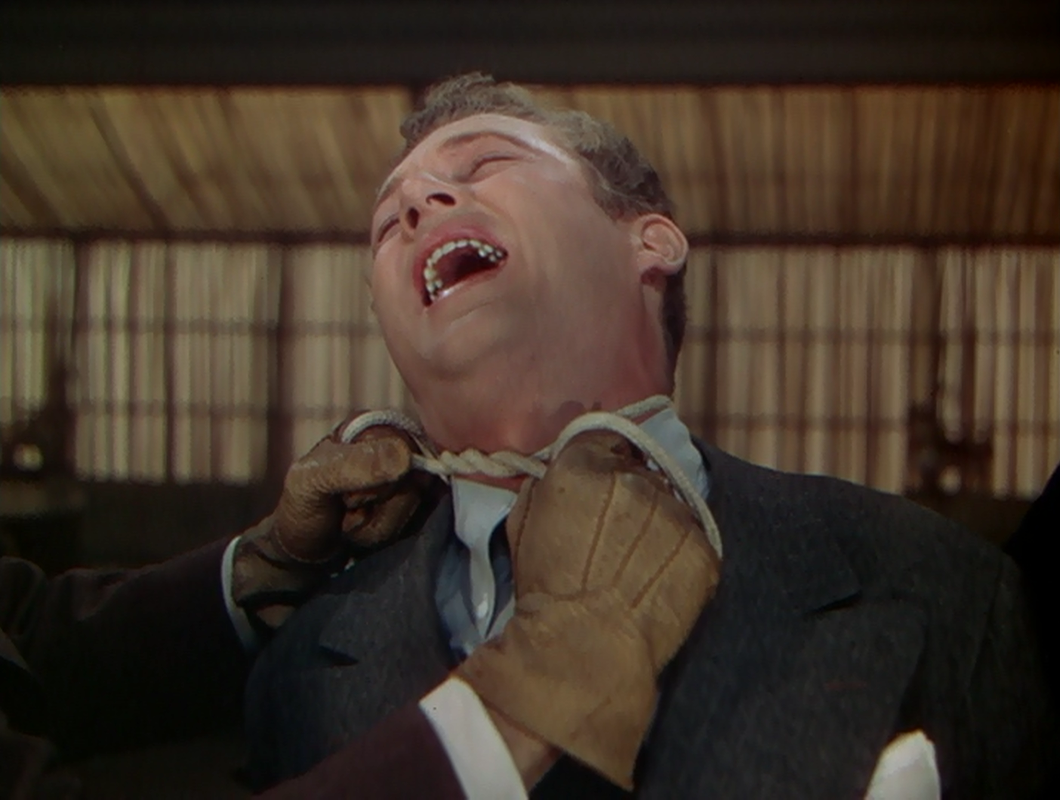
"Nobody commits a murder just for the experiment of committing it. Nobody except us."

Brandon's glee is countered by Phillip, played by Farley Granger, who immediately regrets the couple's decision and begins to assume the worst. Phillip has a good reason to be concerned, because the second part of their plan involves hosting a dinner that night, in the apartment, with David's body resting as peacefully as possible in the chest from which dinner will be served. The guests for this dinner party include David's parents, David's girlfriend, another classmate, and Rupert Cadell (Stewart), the headmaster from school who gave Brandon the idea that murder could be justified in the right situation.

If this one-setting dinner party sounds like a stage play, that's because it originally was. And Hitchcock, eager to experiment while making his first color film, worked meticulously to frame the film as a play. Running at almost real time - there's a little bit of speeding up time during the evening to keep the film at a crisp 80 minutes - Hitchcock managed to shoot the film in a series of 4-10 minute takes, concealing the cuts as well as possible to make it appear that the camera never stops rolling inside the apartment.

Much like the camera, the conversation at the dinner party never seems to stop either. Brandon and Phillip allow their guests some time to talk about simple things, like books and movies - including a humorous sequence where Stewart attempts to talk about movie stars like James Mason and Cary Grant with the two female guests - but eventually the topic of murder finds its way into the conversation.
It's at this moment that Stewart gets to shine as only he can, preaching the idea that murder should be used for personal gain by certain enlightened individuals as the other guests in the room wonder if they should laugh at his idea or fear him. Brandon, still riding the high of finally testing this theory, leaps at the opportunity to guide the discussion, and his back and forth with Rupert leads the conversation to a rather abrupt end when David's father - who still expects his son to show up at this party - becomes shocked by the implications of it.


"Who is to decide if a human being is inferior, and therefore a suitable victim for murder?"

Brandon backs away from saying too much at this point, but he continues to push the envelope as the night goes on, particularly when he brings the rope that was used as a murder weapon back into the film. The viewer knows that he's taunting the guests and especially focused on Rupert, who he obviously respects and may even have feelings for (the original play implies that Rupert also had homosexual relations with one of the killers, but this is muted in the film). Brandon is kind of an ancestor to those overly talkative villains we're used to seeing in super hero and James Bond films, seemingly wanting not only to get away with a crime but have his crime understood by the people who could stop him. Dall shines as he does this, and Hitchcock's choice to pair him and Stewart against Granger's crescendo into drunken anger throughout the evening creates a intriguing game of cat and mouse as we watch to see if Brandon and Phillip's perfect plan will go off as they intended.
It's sad that the controversy that was most notable about the film upon release was its homosexual overtones, because the philosophical debate about murder and where it can rank on the scale of right and wrong is really the most interesting thing about Rope. There aren't a lot of films - especially films from the 1940s - that are willing to sit on the screen and debate whether or not murder is a good idea or not. It wasn't a comfortable topic then - Stewart even said after the fact that he wished he hadn't made the film - but today it still feels like one of the most fresh topics in any Hitchcock film. The script handles the debate expertly - even though it clearly guides us to understand the wrong in Brandon and Phillip's action - and Stewart's work in the final sequence is among the best he ever did. If you know anything about James Stewart (I think he's the greatest actor that's ever lived, but that's a debate for another day), that's a big accomplishment.

The problem with Rope - that's a very good problem to have - is that it's that misfit in both Hitchcock's filmography and in cinematic history. There are not enough films like this; films that are willing to challenge the viewer to think differently about macabre topics. Which made finding a double feature partner for Rope one of the more difficult decisions I've made since I started the Double Feature Picture Show. Here are a few of the things I considered:
  • Murder is the centerpiece of Rope, and murder needs to be a topic of debate in the film we're pairing it with. But we don't want a movie that's just about murder for the sake of murder, we need something that focuses on not just why the murder is happening but why the murder matters in the film's world.
  • As I've already said, Rope makes it pretty clear that we shouldn't sympathize with its killers, even though poor Phillip really does seem like he knows from minute one that he's made a huge mistake. Despite that, Rope still tries to keep us thinking about whether or not the murder could be justified. That's a theme that not a lot of movies are willing to attempt, so I want something that follows that lead.
  • I thought long and hard about the real time(ish) and one-setting aspects of Rope, but they don't really work with a lot of films. I love the technical gimmicks at the center of Rope, but I'm willing to abandon them in favor of a film that manages to convey some of the same themes.
  • The idea of murder as an "art" that only the gifted should be able to perform is a common theme in a lot of movies - especially when it comes to serial killers and sociopaths - but it's the romantic attachment to that art that Brandon shows throughout Rope that really sells this film's approach toward justified murder.
And it's that last point, where I started thinking about characters in film who murdered because they believed they had the right to do so, that led me to a film that's very different than Rope, but very committed to the same idea that some murders...well, they just have to happen.

Frailty
2001, Directed by Bill Paxton

Rope took us into the minds of two murderers, one giddy about the opportunity he has been given and one repentful. Frailty, the 2001 directorial debut by legendary character actor Bill Paxton, also gives us multiple murderers who have varying levels of commitment to the actions they are a part of. Like Rope, the motivation for these actions is clearly vocalized by one character, but the reasons for killing, the amount of killing, and the actions of the killer are all handled very differently in this religion-based horror feature.

Matthew McConaughey - in that awkward phase between his early career success and his rise to Oscar status in the 2010s - stars alongside Paxton, playing the adult version of Fenton Meiks, a man who walks into an FBI office late one night to tell an FBI agent (Powers Boothe, an acceptable substitute for the late James Stewart) the story of how his father and recently-deceased brother lived as "The God's Hand Killer" in a rural part of Texas. 

As a cold and beaten down Fenton relays his tale to the agent, we spend most of the film in flashbacks to his childhood, where Fenton and his brother Adam watch their father (Paxton) change from a simple life as a mechanic to a motivated serial killer who wants his boys to help with a series of murders. Why on earth does this man decide he needs to kill a list of people who he's never met? 

Because he was chosen by God to dispose of people who aren't people. They're demons.
Dad (his name is never spoken by his children, so that's all we have to go with) spends a lot of the movie explaining what is going on to his sons, and most of the film' s drama comes as young Fenton (Matt O'Leary) struggles with the fact that his father and younger brother (Jeremy Sumpter) believe that they are serving God by murdering people they've never met before. The two child actors do a fine job and carry most of the film, while Paxton manages to make Dad a brutal man who is surprisingly tender and straightforward with his sons.

Things start to get weird as Frailty goes on, because some of Dad's predictions are incredibly accurate. Adult Fenton explains this away to the FBI agent by saying "Sometimes, the truth defies reason," and that's about the best explanation we can get for why the father and sons seem to be able to carry out kidnappings and murders with little to no resistance. Dad and the young Adam are convinced that God is protecting the family and sending them everything they need to complete their crimes - including a now iconic axe with the name Otis carved into it - and one of the coolest things about Frailty is how it manages to sell this concept to the viewer.
Rope was a film about two killers with very little room for error, but Frailty flips that concept on its edge as everything just seems to go right for these killers. It's ridiculous to think that what this father is telling his sons is true, but Paxton and screenwriter Brent Hanley (who has, shockingly, never written another feature) do a wonderful job of keeping us guessing as the film goes on. I might have said too much about the plot already - seeing this with no knowledge of what it was about back when it played in theaters is still one of the great shockers of my cinematic life - but even if you haven't seen it and you're starting to make guesses about the film as I write this, I'm willing to bet you'll probably be wrong.

Frailty and Rope are both movies that are best experienced by open minded viewers who know little about them and are ready to get philosophical. This means that I've possibly made viewing them less enjoyable by talking as much as I have so far - way to go, Michael - but I'm pretty excited by just how unique this pair of films are together. One film is about murder that's justified by intellect or class, and the other is about murder that's justified by dedication and belief. You could even re-title them as Liberal Murder Story and Conservative Murder Story, as these are obviously killers on two different ends of the spectrum in American society.

In Rope, Brandon explains away his indifference toward his action by saying "Good and evil, right and wrong were invented for the ordinary, average man - the inferior man - because he needs them." He might as well have been talking directly about Dad from Frailty, because there's no reason this man kills anyone without his belief in good and evil. This isn't a shock - religion has probably been the cause of more deaths than anything else - but it does perfectly explain the difference between why he's killing and why Dad is killing.
While introducing an episode of his own show, Alfred Hitchcock Presents, The Master of Suspense once quipped "I think everyone enjoys a nice murder...provided he is not the victim." That's a nice way of reminding us that murder is going to happen and if you're on the receiving end it doesn't matter if a killer is Harvard educated or an auto mechanic. Both of these films spend very little time humanizing their victims - but we're not here to enjoy their work anyway. These are two films about getting away with murder and why murder can happen for reasons you might not expect. Hitchcock made enough money selling murder that he could confidently remind us that murder is a completely nonpartisan affair, and I think he'd appreciate the opposing approaches to killing that exist in these two films.

So, if you're ever feeling particularly morbid and want to sit down and see some people from different walks of life commit murders for some unique reasons, this might just be the double feature for you. I hope you don't get too morbid and too inspired by them, but if you do - just know that I also wouldn't enjoy being the victim.

Wednesday, September 6, 2017

Volume 10 - Rear Window and the Well-Intentioned Voyeur

Last week we kicked off Alfred Hitchcock Month! with a lot of speculation and a big leap of faith. On the other hand, this week's double feature is one of the easiest I'll ever pick. In fact, the only challenge in putting this double feature together will be stopping me from rambling forever about how much I love these movies.

Why do I think it's going to be hard for me to contain my enthusiasm about these movies, you ask? Well, it's because we're starting off with my favorite movie. Ever. Of all of them. The one I would chase through the gates of hell, and fight my way back to heaven with.

See? I'm gonna get loopy writing this. So let's stop introducing it and start talking about it.

HOW THIS WORKS
Step 1) I pick a movie.
Step 2) I tell you about the movie.
Step 3) I tell you what we're looking for in a double feature movie.
Step 4) Another movie!
Step 5) Victory!
Rear Window
1954, Directed by Alfred Hitchcock

I was 12 years old when I first saw Rear Window, and I immediately knew it was something special in my life. I don't think it became my favorite movie that day - at the time I'm not sure I even had a favorite movie, though it might still have been The Adventures of Milo and Otis (It's really cute, you guys!) - but I immediately identified with it on a personal level. It felt like what I wanted my life to be, with a few cosmetic changes. It was also the first Alfred Hitchcock film I saw, and that set me loose to keep visiting the man who would become my favorite director forever.

I was always looking for strange things as a kid. I've talked in the past about my (most likely imagined) run in with a UFO, and how easily influenced I was by ghost stories and the idea that something strange could be going on around us. You might say I had a wild imagination, but really I was just hoping for something a bit more interesting than going to school and working on our hog farm with my dad. So I started watching everything around me a little more closely. The problem was we lived in the middle of the country; there wasn't much to look at that wasn't pigs and corn.

This is not a problem that was shared by L.B. Jefferies, a.k.a. Jeff (James Stewart), the lead character of Rear Window. Jeff lives in busy New York City, and there's a lot going on in his world. His problem is that he's stuck in a wheelchair with a broken leg - which means that he can see what's going on around him, but when it comes to his ability to interact with it he might as well be living in the middle of nowhere too.

Looking out the rear window (Hey, that's the title!) of his apartment, Jeff can see into the lives of most of the neighbors that live across the small courtyard below. They're a unique bunch of individuals, ranging from the ballet dancer Miss Torso to the eternally longing Miss Lonelyhearts to the songwriter who gets his inspiration "from the landlord, twice a month." None of these names or personalities are the ones these characters claim, they're just what Jeff sees and assumes while sitting in a chair all day. For all we know, Miss Torso might be a really flexible astrophysicist. But we aren't seeing her world through her eyes. We're seeing it through Jeff's.

Jeff's one room world (we know he's got a kitchen and a bedroom, too, but we never see them) isn't completely boring, because there are two truly amazing characters that keep coming into it. The first is his nurse, Stella (Thelma Ritter), a fast talker who's ready to contradict Jeff at every turn, seemingly because she just really enjoys being right. Jeff has a similar problem - at one point he's accused of making an argument "intentionally repulsive" and replies by chiding that he's "only trying to make it sound good" - so his relationship with Stella becomes a wonderful back and forth that gives the film life quickly during the opening scenes.

The second character who graces Jeff's apartment with her presence is his girlfriend, Lisa Carol Fremont, a character brought to life by the unequaled talent and beauty of Grace Kelly. And when she first brings that talent and beauty to the screen, in a slow motion shot of her face swooping in to wake a sleeping Jeff with a kiss - My God. My heart stops every time I see that shot. It's the most beautiful moment in the history of film.

Lisa Carol Fremont might be a gorgeous fashion model, but - like Stella - she's quick with her words too. She argues with Jeff as well, mostly because he's convinced he needs to drive her away. What is it with all these men in movies who try to keep Grace Kelly out of their lives?

(Personal note: Having loved this movie most of my life, I like to think I learned a lot of my personality from Jeff. And while there are so many things about him that I love - his passion to never give up, his humor, his willingness to stand up (but not literally, there's a cast) against what's wrong - the one thing I wish I hadn't picked up from him was this tendency to assume you're a waste of others' time. Then again, maybe I already had that, and maybe that's part of why I relate to him so much? Who knows? Let's get back to the movie, why are we wasting time on me?)
The problem that arises from Jeff looking out that window is that he begins to believe that a salesman across the way (Raymond Burr, who many believe Hitchcock made to look like the former boss he hated, David O. Selznick, for this role) has murdered his wife. We know Jeff hasn't been sleeping right, and we know he's cooped up and hungry for adventure, and we even know he's a little bit depressed (again - he's trying to push away Grace Kelly). So it's hard to believe that he's right...but then again, this is an Alfred Hitchcock film.

It's not the argument about whether or not Jeff is right that makes Rear Window so perfect to me, though that's a real fun bit of the picture. Jeff also brings a smug friend who happens to be a detective (Wendell Corey) into the apartment, and that character seems to keep popping up in the film just to make us think Jeff really is just a guy with an overactive imagination. Lisa and Stella end up taking Jeff's side, which makes the banter with the detective even more fun when they are involved, but it's the moments where Jeff and Lisa realize they might be wrong where the movie really soars for me.

I've talked a lot about the arguing and the banter in this movie, and that's because to me this might be the film with the snappiest, most perfect dialogue ever written. I can't tell you how many throwaway lines in this film are part of my every day language. I'll call out an "ordinary run of the mill Wednesday" from time to time and point out that I'm looking for something "dramatically different" when I'm seeking a movie to watch. Sometimes I borrow some of Stella's homespun philosophy on relationships when I'm feeling blue. I might laugh more watching Rear Window than I do watching any other film, because even after all these years the dialogue is still so punchy to me. Heck, I wanted to make sure I had a quote right in my brain just now - I did, don't doubt me - and the cool thing is that I just typed two words from it into Google because I was pretty sure no one has ever used those two words together like Rear Window did. Sure enough, that quote was the first thing that popped up.

Getting back to those doubts I just mentioned - there's one piece of dialogue in the film that has blown my mind for nearly 25 years. Lisa and Jeff have just had their hopes of catching the murderer attacked again by that reasonable detective, and as they fall silent Lisa speaks up...

"Jeff, you know if someone came in here they wouldn't believe what they'd see? You and me with long faces, plunged into despair, because we find out a man didn't kill his wife. We're two of the most frightening ghouls I've ever known."

I think I fell in love with words the moment I heard Grace Kelly say that. I always liked reading and writing as a kid, but I never though that writing could produce something like that. The dread that lives in that statement, the perfect combination of sadness and humor, the self-awareness to know that you made a mistake and you're not quite sure who you are right now, but also knowing that your feelings right now are kind of a farce. Lisa and Jeff really haven't harmed anyone in this moment, but their whole situation has just been made to appear totally ridiculous and Lisa (the wisest character in the film, by far) can see right through it. John Michael Hayes got an Oscar nomination for this script, and this line alone makes me think he should have won the award and had it renamed after him. It's so perfect that it makes me say farcical things too. If that makes me a frightening ghoul, I'm freakin' proud to join the club.
I said it earlier, and I'll say it again - this is an Alfred Hitchcock film. You buy the ticket, you take the ride. And you know that ride's not going to end with everything "wrapped up in a neat little package," like the episode of The Simpsons that parodied this film (Bart of Darkness, Season 6, Episode 1) would have us believe. As Hayes and Hitchcock drive us to the final reveal there are plenty of twists and bumps, and every one of them will make people like Jeff and I and any other well-intentioned voyeur with a passionately paranoid mind grin and prepare for the next one. Rear Window keeps us involved in a murder mystery not by taking us on a cross country adventure - Hitch saved that for North by Northwest and other films - but instead by making us jump to conclusions inside our own minds as we try to understand how all the pieces of this potential murder could fit together. 

When you're a slightly ghoulish dreamer that can't go anywhere - either because you're trapped in a wheelchair or because you're a preteen on an Iowa farm - those are the kind of adventures you get to go on. Apologies to the UFOs and the ghost stories, but when I met Rear Window I realized it was the kind of adventure that - while completely implausible - could actually happen. And it inspired me to try to be quicker, to be more observant, to choose my words for their impact and not necessarily their meaning, just in case I need to make my point "sound good." I'm not sure if I understood this all when I was 12 - I've been rambling so much that I might read this back to myself and not understand it now - but I know Rear Window set my life on a new course that night. 

And that's probably why Rear Window will always be my favorite movie. It makes me want to always be prepared for anything, even when the only thing I can do might be to offer a humorous retort or a crazy theory.

One thing I learned quickly after I saw Rear Window is that it's one of the most copied films ever made. I don't mean that in a bad way - like the man said, "imitation is the sincerest form of flattery" - but it does make picking a double feature to go with it a different kind of challenge. A lot of times it's hard to pick one movie to go with a movie, this time it's hard for me to pick just one. 
  • The basics of Rear Window are basically their own subgenre by now. Someone sees something, or thinks they see something, and then no one believes them. The part where a lot of films that borrow this set up fail is that they show the audience too much. You lose that joy that I got from following Jeff and Lisa's theories when you do that. Like I said above - the mystery needs to be in the lead character's head.
  • The other thing that makes Rear Window so unique is Jeff's predicament. He's alone and he can't do anything. We don't necessarily need to duplicate his injury, but we need a film where the lead really can't act most of the time and where he's slightly unreliable. He needs a couple of people to bounce his ideas off of, obviously, but we can't give him too much help.
  • More than anything else - we need a movie that doesn't just feel like a rehash of Rear Window. We need a movie with Hitchcock's spirit. I'm looking for something by a director and writer that has a good understanding of Hitchcock. And there's a guy out there who fits that description who might not be the one you're thinking of.
How can I follow up my favorite movie and not feel like I'm taking a gigantic step backward? Because I'm picking a movie by a director whose experience with Hitchcock started a bit like mine.

Road Games
1981, Directed by Richard Franklin

Like me, Richard Franklin was 12 years old when he saw his first Alfred Hitchcock film. Unlike me, that film wasn't Rear Window; it was Psycho. That doesn't matter though, he became devoted to Alfred Hitchcock too. The Australian born Franklin took a more direct approach to his fandom - he became a filmmaker. He ended up making his way to the University of Southern California in 1967, and during his time at the Los Angeles based university he managed to get Alfred Hitchcock himself to come host a screening of one of his films, Rope. Then, Hitchcock invited Franklin to come watch him work on set while he was making one of his final films, Topaz.

If that paragraph makes you insanely jealous, you're not alone. Imagine being a young filmmaker and not only being able to talk film with Alfred Hitchcock but also being able to watch Alfred Hitchcock work. I know a lot of people will warn you about meeting your heroes, but man I would love to have been in Richard Franklin's shoes. Franklin went on to direct the long overdue Psycho II in 1983, and the work he did making what appeared to be an unnecessary cash in into a truly entertaining film is enough to earn him my eternal admiration. And that's not even the best tribute to Hitchcock he made.

Franklin returned to his home country after school, and worked his way up to making features by the end of the 1970s. In 1981 he made one of the most expensive Australian films of the time - Road Games

The simple way to describe Road Games is as "Rear Window in a Semi," but that's a disservice to Franklin's film. The set up is similar - Quid (Stacy Keach), who's driving a truck full of pork across Australia, begins to believe that another driver on the road is killing hitchhikers - and starts to try to solve the case. Unlike Jeff, we see in the opening scenes that this unnamed man - Quid refers to him as simply "Smith or Jones" - is a killer, but we also know that Quid doesn't know this.
Keach will probably never be listed next to James Stewart on many lists of actors in cinema history, but his performance as Quid is a one of a kind treat. Like Jeff, Quid's mind is open to all kinds of possibilities. He's been sleeping in his truck, the only soul he has to talk to most of the time is his pet dingo, and as he drives across the country he starts to come up with stories about the people he passes on the road. Some of these characters draw a direct parallel to Rear Window's - though Franklin's picture of how newlyweds act in 1981 is a bit more direct than Hitchcock's was in 1954 - which makes it even easier to see the influence Hitchcock had on this director.

But Quid is an angrier (If you call him a truck driver he'll snap back with "Just because I drive a truck does not make me a truck driver.") and more active character than Jeff. He's obviously more physically active - he can get out of the truck and walk around, but he's still facing a deadline that keeps him confined to the truck for most of the film - and he's also more mentally active. Road Games gives Quid a couple of people to talk to - most notably an American hitchhiker played by Jamie Lee Curtis (another significant Hitchcock connection, since she's the daughter of the star of Psycho) that Quid playful refers to as "Hitch" - but Keach is at his best when Franklin puts him behind the wheel and lets the thoughts that are running through his mind fill our ears.
As viewers, we know Quid is right about Mr. Smith or Jones. But watching him go through the facts and hearing what's going through his mind, especially once Hitch becomes part of the game of cat and mouse between the two drivers, pushes the tension in Road Games to wonderful levels. Franklin comes up with a brilliant trick to render Quid immobile during the final showdown, and by that point we don't need the mystery about whether or not he's right to keep us caught up in this film.

When you look at the films that have imitated Rear Window, there are examples that resemble it more directly. One of the most recent examples is Disturbia, a procedural 2007 thriller starring young Shia LaBeouf. Credit where due, Disturbia didn't drive me crazy as a Rear Window wannabe. Any movie that allows David Morse that much sinister screentime is worth something. But it's a movie where someone who loves Rear Window is going to look at it and say "Oh, it's just a movie that's doing Rear Window." That's not a crime, and it's kind of exciting. I remember seeing the trailer for Disturbia the first time and, after an initial moment of shock, thinking how cool it was that people were still wanting to be like my favorite movie more than 50 years later. But the cool thing about Road Games is not that it wants to be like Rear Window; it's that it wants to be like Rear Window and still manages to be funny and ghoulish and thrilling and actually feel like something Alfred Hitchcock would have made.
Richard Franklin got a direct line to Hitchcock while learning his trade, and he was able to use it perfectly in this film. He didn't just make a film that reminds me of my favorite film, he made a film that reminds me of my favorite film and manages to be one of my favorite films on its own merits as well.

I don't know if it's a requirement to be 12 years old to fall in love with Hitchcock and decide to devote a large portion of your life to loving Hitchcock's films, but I'm glad Richard Franklin was able to do it and you probably don't need me to say by now that I'm glad that it happened to me. Rear Window has been a defining piece of my personality - heck, it's a defining piece of my life - for more than two decades, and Road Games just happened to follow along behind it and become a perfect companion piece to it.

This might be my favorite double feature of all-time, guys. As Stella would say, Rear Window and Road Games are two great movies about "a pair of maladjusted misfits," and they make me want to be one of those, too. 

Wednesday, July 19, 2017

Volume 3 - Blue Steel and the Rise and Fall of the Steamy Flick

This week I think I found two movies that form one of the creepiest couples I could ever create. I don't mean creepy in the cool "Hey, Vincent Price is creepy!" way, I mean creepy in the "Dude, these filmmakers really threw a lot of craziness on screen just to see what would stick." way. The '90s were a weird time, man. One of the reasons the '90s were such a weird time is the rise in what most critics would call "erotic thrillers." I like to call 'em "Steamy Flicks."

You know how some film historians - Paul Schrader, for example, wrote an essay on it - claim that Film Noir was a movement, not a genre, and it only lasted during a certain time frame? (From Double Indemnity in '44 to Touch of Evil in '56, if you're asking.) Steamy Flicks might have been the same kind of thing, because they blew up from the arrival of Fatal Attraction in 1987, and I think they might have ended around the time the second half of tonight's double feature, or possibly when David Caruso decided to be like David Caruso in Jade. It was a time and place when people spoke with their wallets at the box office, and their wallets apparently said "We want to see women (preferably blondes) have crazy sex (preferably with Michael Douglas)."

Now, I haven't researched this entire movement and its place in Hollywood history. I was only 14 or 15 when it all but died out in the mid-'90s; I've been learning and playing catch-up ever since. But I'm pretty sure the two movies I'm gonna talk about tonight are two of the craziest Steamy Flicks from that time and place. 

That place is New York City.

HOW THIS WORKS
Step 1) I pick a movie.
Step 2) I tell you about the movie.
Step 3) I tell you what we're looking for in a double feature movie.
Step 4) Another movie!
Step 5) Victory!

Blue Steel
1990, Directed by Kathryn Bigelow

Steamy Flicks hadn't hit their prime popularity yet in 1990 - that would come two years later when Basic Instinct became a pop culture thing - which means that Kathryn Bigelow's Blue Steel didn't have to follow some of the rules that Verhoeven's film made for this cinematic movement. That's a really good thing, because Bigelow and co-writer Eric Red (who had teamed together previously on Near Dark) had a little more freedom than they might have had if Sharon Stone was already a household name. They made their movie crazy, but it was at least their own kind of crazy. That's what makes it one of the best of all Steamy Flicks.

Blue Steel is the story of Megan Turner (Jamie Lee Curtis!), a rookie cop who admits flat out that she wanted to become a cop because she craves action. Apparently they didn't have psychiatric tests for police officer women (Thanks, Hot Fuzz) in 1990 NYC, and that's fine, because Megan is kinda mostly sane. It's just that she has pretty bad luck.

Megan gets her first taste of action early in the film, and it doesn't go extremely well. She rushes into a NYC grocery store because she sees a gunman (a youngish Tom Sizemore) attempting to rob it, and she ends up gunning him down before he can do the same to her. In the chaos that follows, one of the onlookers, Eugene (Ron Silver), manages to grab the robber's gun and leave the scene before Megan can clean things up. Why would Eugene do that?

Because Eugene is CRAZY.

I don't like to call people crazy. It's not a nice word, nor is it the technical term. But if you lined up all the people in all the movies of the 1990s, and ranked them by mental illness, I'm willing to bet that Eugene would be in the top five or ten craziest.
What makes Eugene crazy, you ask? Well, here's a quick timeline of what happens before Blue Steel gets REALLY crazy:
  • Eugene steals a gun from the crime scene, leaving poor Megan's shooting under investigation because apparently no one else saw the robber's gun.
  • Eugene uses the gun to kill people, starting with an old man who seems too innocent to even try to not get killed while expressing his disbelief that he's about to be killed.
  • Eugene carves "MEGAN TURNER" into the side of the bullet he uses to kill the old man, leaving Megan facing even more questions from Internal Affairs and a nice, but tough, cop (with beautiful curly hair) played by the marvelous Clancy Brown.
  • Eugene lifts weights, which wouldn't be entirely creepy if he didn't start hearing voices while doing it, then start arguing with himself, then lift weights more violently.
  • Eugene not only continues to kill people, but he does things like going to a rooftop, stripping nude, and wiping the hooker-he-just-murdered's blood-drenched sweater all over his face and body.
  • Eugene uses the word "misanthropic" to describe his job as a commodities trader. Maybe that's not crazy, but it's a warning sign.
Oh yeah, and Eugene also manages to bump in to Megan on the street, put on the charm, and start dating her.

I KNOW. If you told me these were things that happened in a movie about a rookie cop who is just trying to get a little action, I wouldn't believe it either. But that's Blue Steel. And there's a lot more twists from there, I'm not giving too much away.

Now that I've gotten that craziness out of the way, let's get back to Megan Turner, as played by the still virginal in my mind Jamie Lee. She falls madly in love with Eugene. Maybe it's because her father doesn't like her being a cop, maybe it's because all the other men around seem to be shouting at her, but it's probably because Eugene seems to have a caring personality when he wants to.  He's sweet to her, and she's not used to that. One one of their earliest dates she kind of breaks down, possibly because the rest of her life just isn't working out right now.

Megan:
"I'm actually happy, very happy to be here. I feel like I'm on top of the world."
Eugene:
"Wanna get higher?"

At this point you might expect me to tell you that Eugene then gets Megan addicted to crack and starts riding her around the room like a pony. But NO. That's not what happens. He takes her for a ride in a helicopter. Over New York City, at night, with the wind in their hair and smiles on their faces. It's actually really lovely. At the end of the night, they share one of the most beautifully framed kisses I've ever seen on screen.
But, he's crazy. So things don't stay so lovely. And that's when the game of cat and mouse gets really fun. Blue Steel isn't one of Bigelow's most respected films, and you could possibly argue that she did the relationship between cop and criminal better a year later in Point Break (which would make a fine double feature with this too). But the thing I love the most about Blue Steel is just how willing it is to sell this crazy relationship between a kinda messed up cop and a totally messed up beyond belief killer. Bigelow and Red are in perfect control of a film that is perfectly out of control, and that makes it so much fun.

Now, what do we need for a double feature?

  • Blue Steel is blessed with the unique couple, Curtis and Silver, that leads its cast. It's a pairing that you wouldn't really expect, and yet they play off each other incredibly well. This is mostly because they're two great actors, but also because they have an awkward, yet palpable, chemistry with each other. We need leads like that.
  • Blue Steel also brings a stacked supporting cast to the table. I mentioned Brown and Sizemore, but you can also keep your eyes open for such all-stars as Elizabeth Pena, Matt Craven, Kevin Dunn and Richard Freakin' Jenkins. That's a great cast. We need a movie that has some heavyweights around the leads.
  • I talked about the Steamy Flicks movement in the opening, but Blue Steel is actually pretty tame compared to some of them in the Steam department. If this double feature's gonna make any sense, I gotta take the Steam up a notch with movie number two.
  • One of the things I think about every time I see Blue Steel is whether or not Megan is a problematic character. She's a strong, independent woman who can hold her own most of the time, but she also lets herself get caught up in the moment and falls in love with a crazy guy while occasionally getting in trouble because of her action fueled desire to be a hero. The movie solves this debate by the time the credits roll - and does so emphatically - but it's still interesting to think about the female lead and her choices when Hollywood so often struggles with characters like this. So, I'm looking for a female lead who's got some issues that the film has to work out.
  • Also, I need to find a movie crazier than Blue Steel. I know that sounds difficult when you read all that stuff I said about Eugene, but I'm looking for a movie that does some insane things. Maybe a movie that has a montage where they cut together a series of trust falls, a snowball fight, and a sex scene. 
That movie, thankfully, exists.

Never Talk To Strangers
1995, Directed by Peter Hall

It's 1995 and we're in New York City. It's been five years since the events of Blue Steel (You can't prove that this isn't a shared universe, so back off!), and criminal psychologist Dr. Sarah Taylor (Rebecca DeMornay) is at the top of her game. She's working on the case of an accused serial rapist, Max Cheski (Harry Dean Stanton!), who might have Multiple Personalities Disorder or might be schizophrenic or might be a mastermind of crazy like Eugene was in Blue Steel. As we watch their sessions together it takes maybe seven words for us to realize Stanton, as you would expect if you know his work, is killing it in this role. Cheski is kind of a laid back version of Hannibal Lecter to Sarah's Clarice Starling, so when she asks "How often when you say you suffer from bouts of dementia?" and he responds with "I don't remember." before breaking into laughter, you start to realize Never Talk To Strangers is going to be the kind of movie where the lead character says the title of the movie, ten minutes into the movie, while doing the exact thing the title of the movie is saying not to do.

Cheski might be the shadiest dude in Sarah's life, but the movie quickly reveals there's going to be a lot of competition in the race for that title. First she's out to a kinky art gallery with her horny neighbor (Dennis Miller), and later her alcoholic father (Len Cariou) shows up and tries to make amends by jumping out of a dark alleyway at her. Between these moments, she meets a stranger in a supermarket (if these two movies taught me anything, it's that people shouldn't meet in NYC supermarkets) named Tony Ramirez, played by the undeniably suave Antonio Banderas.

To her credit, Sarah tries really hard to avoid Tony's advances...for about 2 minutes. He starts up a conversation about how she's choosing the wrong wine, compliments her on her looks, and tries to convince her he's got the right wine for her waiting at his nearby loft apartment. Much like the banter between Eugene and Megan in Blue Steel, he's got the right answers to most of her rebuttals.

Sarah:
"Do I look like someone who can be bought with a great vintage?"
Tony:
"You look like someone...who has to be won."

You might have guessed by now that Sarah and Tony get Steamy soon after this. And, since the bar for Steaminess had been raised by Basic Instinct and its immediate predecessors, this one goes for bizarrely Steamy with aplomb. It's not long before we start to question everything in Never Talk To Strangers, because when we see what Sarah is willing to do inside Tony's sex cage we see that Sarah is all about that Steam. Cheski sees it, Tony sees it, and whoever starts doing things like leaving dead flowers at her door or placing her obituary in the newspaper prematurely starts to see it.
The kissing in Never Talk To Strangers is just a tad Steamier than that of Blue Steel. Lovely doesn't live here anymore.
The biggest difference between Blue Steel and Never Talk to Strangers is their tones. Bigelow kept her film gritty with a focus on the police drama and a restrained musical score, while famed theater director Peter Hall (the father of actress Rebecca Hall) brings an operatic drama and a Pino Donaggio score to Never Talk To Strangers. The movie hits its first peak when Sarah, deep in doubt about Tony due to everything going on around her, realizes he might be a nice guy by participating in trust falls in a snowy park at night.

I hope you've never experienced a trust fall - that weird activity some doofus in the counseling community started where you fall backwards into a loved one's arms, hoping they catch you - because if you have you will be instantly jealous that you didn't experience it the same way Tony and Sarah did. What starts as an over-the-top attempt to convince her she can trust him escalates into a slow motion series of these falls, a snowball fight that devolves into a wrestling match, and (since this is a Steamy Flick) a sex scene. And it's all cut together. One shot of the fall, one of the snowballs, one of the sex back in her apartment, and repeat. It's the best montage since Rocky IV
I'm not convinced that Never Talk to Strangers isn't a terrible movie - especially considering the finale that I won't even hint at here - but it's a perfect example of why the Steamy Flick had to die eventually. There's only so much you can do with the concept. Blue Steel used it to create a gritty police drama, and Never Talk To Strangers uses it to create a melodrama that would almost be Hitchcockian if Hitchcock lost his damn mind and threw every piece of crazy he could think of into an 89 minute movie. (Then again, a Marnie/Never Talk To Strangers double feature might work. I must think on this further.)

The Steamy Flick movement is certainly defined by a mutated venn diagram that focuses on Michael Douglas and Sharon Stone and Demi Moore, but these two flicks that exist outside that framework just seem like they should be crazy best friends. If you're ever in the mood for a bunch of psychological mumbo jumbo, sexual tension that bubbles up in the most awkward ways, and all kinds of surprises - you need to take a trip to Steamy New York City with a Blue Steel/Never Talk To Strangers double feature.

P.S. - Could I possibly say Steamy more times?

P.P.S. - Steamy.